An entire conversation in silence

Engineering is a universal language, and a hardware store is a forum for communication. It happened that I was in need of a special metal part for a prototype of a separate project. I went downstairs to the small hardware store (think of a cube the size of a living room with no internal lighting and one side completely open to the street, filled with 3 short rows of completely random things), armed with my pen and pocket notebook. The first trip I communicated that I wanted a metal hook, similar to a Masterlock, and it had to have a threaded end for nuts. He came up with some u-bolts, which was close, but they were the wrong size and I couldn’t reshape them to what I wanted. So we found some threaded rods and a couple nuts for it and I figured I’d bend the rod how I needed.

After some hammering and bending and sheared rods and a slight amount of blood, I declared myself defeated and went back for another attempt. I showed him my failed piece and what it should look like. I asked him if he could try using his tools to bend it, but he got the same shearing, so we went in search of a more appropriate part. We found a hook that had a threaded end, but there was a metal collar on it, and I didn’t have the tools to remove it. I got him to remove the collar, and then I was happy. He sold me the part, and I left. It turned out that after I did a little bit of work on the part it ended up working perfectly.

All of that; every communication in that whole story, was done without a single spoken word. It was all gestures, props, and drawing. I still feel bad not knowing Mandarin, but I’m getting comfortable enough communicating, or at least trying to communicate using unconventional means, that I’m now having challenging interactions with the locals.

Permanent link to this article: http://engineerinshenzhen.com/an-entire-conversation-in-silence/

Sheets

One of my first experiences interacting with the Chinese was a lesson in futility. Well, a few lessons, really. After a few nights freezing with no sheets and my only long-sleeve shirt being my jacket, I desperately needed sheets. The nearby RenRenLe (the equivalent of Fred Meyer or a Super Walmart) had sheets, and I thought I was going to be able to get what I needed. I had the dimensions of my bed, and I started looking for what I needed. A lady who worked there offered to help, so I drew a picture on my notebook of a bed and the dimensions of it. She seemed to understand, but that was about as far as our communication extended. What ensued was a challenge for both of us that quickly escalated out of control.

She kept pointing to things and I kept not understanding. She would point to the English description of the thing she was putting in my hand, but they were names of sheets that I had never heard before. What is an “enamel cover”? Why was this so complicated?

But it got worse. My whiteness attracted attention, and soon I had 5 staff standing around, trying to understand and help. Then the local shoppers tried to get in on it. Then they started calling people they knew who spoke any amount of English, and trying to get them to translate for me. It was a mess, and I just wanted to be left alone to figure it out on my own.

Eventually I decided it could get no better and that this was futile. I extracted myself as best I could and gave up sheetless.

The next time I came prepared. I had gotten internet on my phone and was able to use Google Translate to say “I do not need help. Thank you.” This was enough to get them to just stand nearby while I figured it out for myself.

However, this was not the end of the story. I had made the mistake of assuming that a large chain store would accept a credit card. When I handed it to the cashier she looked at it, then at me, then at it, then turned it over, and handed it back to me. Unfortunately, I didn’t have enough cash to cover it, so I had to leave the sheets. I went back to the apartment and got some dough, then went back to the supermarket and found the sheets again and brought them home.

Sadly, that’s still not the end of the story. The sheet set I had purchased was missing a fitted sheet for the mattress. It took one more trip to the supermarket, and I ended up with a flat sheet, but I’m making it work. At least now I can sleep. Next I’d like to work on making my mattress less hard than the concrete floor.

This ginormous fail is not a criticism of the Chinese, who really were going out of their way to try to help, but more a realization that sometimes the best help is to leave someone to figure things out for themselves. Also, Google Translate is going to make things a lot easier for me in the future now that I have the Internet on my phone.

Permanent link to this article: http://engineerinshenzhen.com/sheets/

First Meal Alone

It’s strange, but the first meal I had to order alone was on the fourth day in China. I don’t know how I avoided it so long. Having had a few catastrophes interacting with people at the supermarket, I was hesitant to order food from a place I didn’t know where the best I could do was point at something. I am embarrassed to admit it, but my first foray into ordering on my own in a restaurant was at a KFC. To be fair, KFC is HUGE around here, and they are as prevalent as Starbucks or McDonald’s. The menu is different, but similar, tweaked for the Chinese appetite. There was a menu on the counter, and all I had to do was point. She didn’t even bother to ask me what kind of soft drink I wanted. It was purely a matter of pointing, and clearly she had done this with foreigners before, because she knew how to ask me if I wanted it for there or to go, and if I wanted to make a meal with fries and a coke. I sheepishly took my food to a table, and started to dig in when the woman next to me started talking to me in English. She said she did contracts work with foreign companies and asked me if I always had lunch at KFC. I told her this was my first time ordering alone, my first time at the KFC, and that I’d been there 4 days out of 3 months. She offered me encouragement and said many people know a little English and that I should try asking them to speak in English. I told her that I’m in China and I should speak their language and that I felt bad for not knowing any of it but that it was challenging with all the pronunciation and tones. I told her that I was picking up the characters faster.

I’d like to think I’m adventurous, and that I’m willing to just try stuff, but at the same time, this inability to communicate at any level with people is really embarassing and I’m finding myself trying to avoid the embarassment. The people are all very helpful, which only makes my embarassment worse; I’m in their country, I should be able to speak in their language. And yet I haven’t even mastered “thank you.” I can’t tell if it’s pronounced tsi-tsi, or tchi-tchi, or she-she, and every time I get into trying, I go back and forth with them saying it correctly, me trying to repeat it, and them indicating that I screwed it up somehow and repeating it again. It feels hopeless.

Permanent link to this article: http://engineerinshenzhen.com/first-meal-alone/

The Internet here is AWFUL

When planning a trip to China, be aware that the internet is ridiculously slow. Generally, I get dialup speeds. That is, when I have internet. Often it will just die entirely. This is a common problem that everyone I’ve talked to has mentioned, so I know it’s not just me.

For things that do not require a login, I generally just use the internet without protection of a VPN or SSH tunnel. It’s way too slow and unreliable otherwise. But for things like Facebook and many of my email accounts, I run a SSH tunnel to my computer in Wisconsin and then use VNC over that SSH tunnel to connect to that desktop, and then use Facebook and check most of my mail  from there. That part is REALLY slow, so it takes a long time to check my accounts, but I don’t want to give up the security and check stuff without protection.

At the office we have a problem with the wireless networks; for the past week they’ve been going down every few minutes, and when they are up, they are very slow. I ran a test and tried plugging a cable into the router, and that improved the situation significantly. We should be getting wires to our desks soon.

At home, I’m extremely disappointed. Most of the time there is no internet at all. The odd part is that for a few days it worked until 10pm, then died suddenly and didn’t come back until the afternoon the next day. I have a good connection to the router 24/7, so it is my suspicion that someone downstairs is turning off a critical component that connects to the internet when their shift starts/ends and it’s killing the internet, though I wonder if other people are affected. Still, not having internet at home makes me feel like an inmate in my tiny apartment, and it’s hurting my ability to get things done, like update this blog.

My phone now has internet, and that has been good, but with a limit on the amount of bandwidth, I can’t get too excited. I use it for maps, google translate, communicating with people, skype, and checking one of my mail accounts.

Permanent link to this article: http://engineerinshenzhen.com/the-internet-here-is-awful/

Poorly Made In China

One of the recommendations from a presenter was the book “Poorly Made In China”. The book was written from the perspective of an agent who deals with importers who are trying to have their products manufactured in China. Usually he is brought in when there is a communication problem and things are failing. In each of the chapters he writes about something that went wrong. Sadly (for them), many of his stories follow the same company.

There are many lessons to glean from this book, which at ~250 pages was an investment of half a day with potential returns of many times that.

Some of the lessons, shortened and made generic:

  • Listen to the people you pay for advice who have expertise in the field you need. In a few of the chapters people were bull-headed and ignored what was staring them in the face, or passed over expertise that was offered because of past experiences.
  • There are many cultural differences that make working with manufacturers in China difficult, and they are not the stupid things like offering gifts. There are some ways of thought that are completely non-western and thus may seem illogical but aren’t. They often don’t understand the product they are making or why it is designed or functions the way it does, and thus don’t understand how minor modifications to it can be critically consequential.
  • Without constant supervision, manufacturers will do everything they can to make or save money. This includes selling ghost product, replacing parts with cheaper parts, skipping quality control, ignoring safety, and many negotiation tactics that are designed to the benefit of the manufacturer and not the importer. They could destroy tens of thousands of dollars worth of product by saving a few dollars on a cheaper part, and they won’t tell you they changed the part.

The book is pessimistic, largely because the author is often brought in when things fail. It’s a roadmap of landmines to avoid and tricks.

Permanent link to this article: http://engineerinshenzhen.com/poorly-made-in-china/

First Night

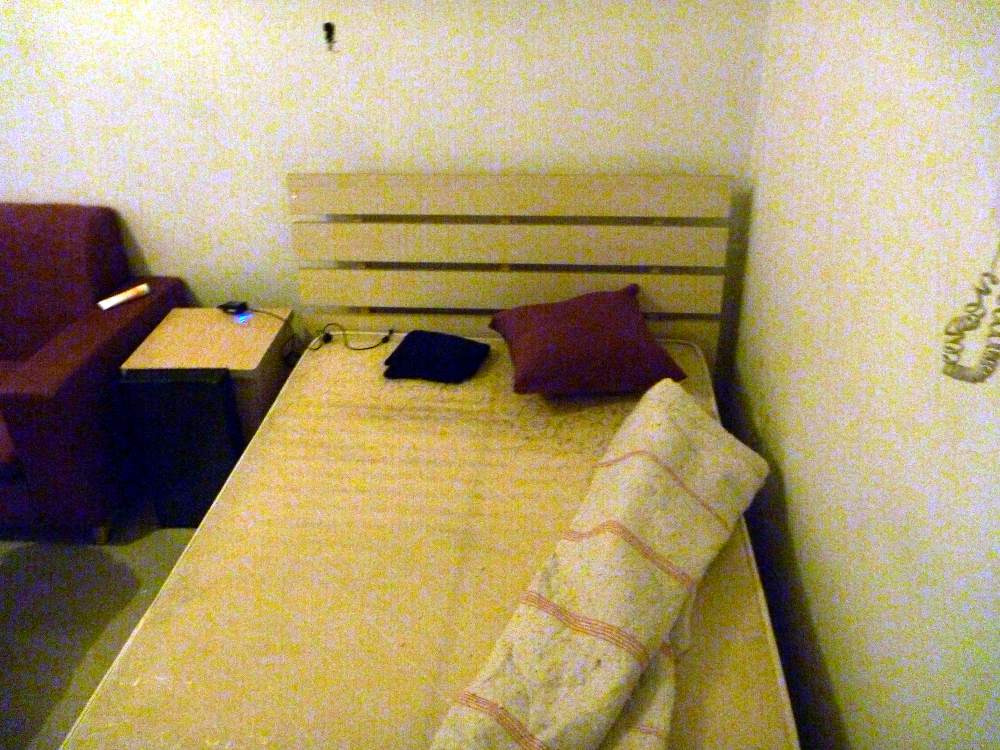
After arriving in Shenzhen and meeting Sammi in front of the apartment, I now had someone I could trust who spoke English, and things were a lot more comfortable. We went upstairs to the apartment, which looked like it was still occupied. There was someone’s stuff all over, and it turned out that they hadn’t finished moving out. It was good enough for the night. I chatted with my guide for a few hours until she had to go pick up another team and get them settled in.

I didn’t have any blankets except the thin one I had taken from the plane. It was colder than I expected, and I didn’t have any long sleeved shirts, either. There was a ratty blanket on the bed (it turned out that this was the stuffing for a comforter and that one normally gets a cover for this thing that zips over it. The bed was hard so the first night I tried having that stuffing under me, the thin blanket on top, and I wore my clothes and a rain jacket. I was freezing the entire night, and didn’t get more than an hour of sleep; but I didn’t even feel tired. In the morning, I was starving, but fortunately had the snack from the plane that I had stowed.

Being 14 hours different from where you were, and crossing the international date line, is strange. I had left on Tuesday morning, February 28. I arrived in Hong Kong at 8pm Wednesday, February 29. Essentially, I didn’t get a leap day. However, when I return on June 13, I will arrive in San Francisco 1 hour after I depart Hong Kong on the same day.

To recap, I had slept for a total of 3 hours since waking up at 4am Tuesday in Madison. So on Thursday morning, I should have been exhausted. I was tired, but not enough to be able to sleep. I slowly got ready for the day, and wandered out to explore before I was to meet my guide at the appointed location to go over contracts for the apartment. As I wandered around, from out of nowhere someone asked me if I was with the same group they were. Lisa and Abe had recognized me as the only caucasian they had seen since arriving and assumed, correctly, that I was in their group. To add to the good fortune, one of them spoke Mandarin, AND we were right next to a food cart. She ordered me some breakfast and I was a very happy boy. We continued wandering around together for a while, chatting and getting to know each other.

Permanent link to this article: http://engineerinshenzhen.com/first-night/

In Transit

Madison

After a difficult goodbye, I went to the ticket counter and checked in and dropped off my checked bag. I was worried that my prototype inside the bag would be examined and blown up as a potential bomb, but it turned out my fears were unfounded. Tickets in hand, I went upstairs and was disappointed to see the millimeter wave scanner was the only option for getting through security. I decided to opt out; not because I think the tech is dangerous, but because it’s extremely intrusive and unnecessary. Clearly the TSA guys had significant training, because they shifted into the cover-your-butt-and-be-as-official-as-possible mode, explaining exactly what they were going to do before I opted out (“if you do this we’re going to violate your rights in a whole lot more ways that you are not going to like, so are you SURE you want to do this?”). They took my bags that had gone through the x-ray and brought them to a separate part of the area, but still in full view of everyone. They asked if I wanted a private screening, and I said yes. The guy called over a manager, and the three of us went into a room. The guy was very civil and explained exactly what he was going to do before he did it. Some day some terrorist is going to stuff a weapon up his butt and the TSA will finally realize how silly all of their obsessive checking is; anyone who is sufficiently motivated will find a way to get through security, so we’re just theater, except we get probed instead of just watching the theater.

After patting me down he wiped his gloves with a cloth and threw it in an explosives detector, which fortunately came up clear. I was free to go, having just been frisked. Sadly it wasn’t my first frisking. The first time was to get into a night club. Why is it that I’ve been frisked twice by people with no reason to believe I’m guilty of anything? It’s not right.
Chicago

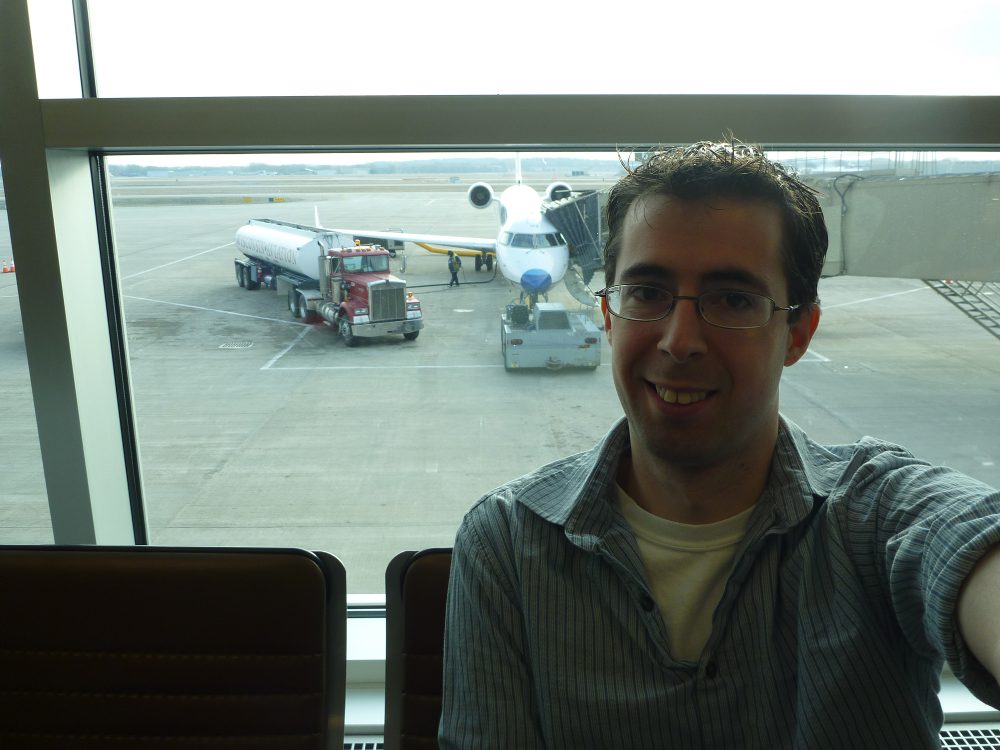
The flight from Madison to Chicago was 27 minutes; quick and painless. I had a few hours to kill in Chicago, so I walked around for a while, then started the Michael Crichton book Airframe, which turned out to be oddly appropriate for my situation.

Over the North Pole

The flight from Chicago to Hong Kong wasn’t anything like I expected. Boarding took only a few minutes because although the plane was enormous, it was practically empty. Everybody in economy had at least two seats to themselves, and a few people stretched out on the center rows across all 4 seats. The guy behind me chatted with me for a while, saying that normally the flight was pretty full, that during Chinese New Year it was completely full, and the recent end of the new year probably explained the emptiness. Shortly after takeoff, the staff asked us to lower our windows, making the place dark. After a couple hours, we were served a dinner, then the cabin lights were turned off, and we were meant to sleep.

My plan had been to stay awake for the entire flight and try to make myself exhausted so that I would sleep when I arrived at the apartment. I had an entire season of a show on my phone, and planned to plow through it. It was clear, though, that the airplane intended for us to have a 16 hour version of a 24 hour day. After dinner, the lights went out and almost everyone slept while some movies and sitcoms played. I watched a couple of the movies and episodes on my phone. Eventually, I decided to try to sleep for a couple hours so that I’d be rested enough to get to my apartment but not so rested I couldn’t sleep. There was a snack halfway through which resembled a breakfast, and I put it in my bag for later. The attendants frequently walked through the cabin with cups of water; a disappointing change from non-U.S. carriers where the cups are filled with wine and beer. Eventually the lights came on and stayed on for a few hours. A couple hours before landing we were served another dinner, since we were landing after 7pm.

Occasionally I would peek out the window, but sliding the window open any amount let in a lot of reflected light, so I did it only briefly. I saw the Hudson Bay, the Arctic, and northern Russia and China. Unbroken tundra and snow for hundreds of miles. It was pretty spectacular. Even as we approached Hong Kong and the sun finally got ahead of us and set, I couldn’t see any sign of life below. The descent into Hong Kong was foggy, and it wasn’t until we were on top of it that I could see the city.

Hong Kong

The arrival was easy. I went through immigration quickly without a word exchanged. No visa is required for Hong Kong if you are staying for less than 90 days. I wasn’t even staying 1 and I had the China business visa for mainland, so I was good. We had arrived too late for the ferry, so I headed to the baggage claim to get my bag, which was the first bag out for my flight. Then I walked straight through customs with nothing to declare. There wasn’t even a stop. It was very fast.

I tried to find a bus to take me to Shenzhen, as that was cheaper than a limo or taxi, but faster and easier than the metro. A lady tried directing me to the limos, but I declined. After some failed communication, I managed to purchase a ticket on a bus that would take me to the border with the mainland. The bus came and I got on. In all, the airport was a pretty painless operation. I even had cell signal with my T-mobile SIM for long enough to dash off a message to my girlfriend.

Shenzhen

Before arriving in Shenzhen, the bus had to stop at immigration. Everyone got off and went into a building. The bus passed through and waited for us on the other side. Again, it was just a matter of handing the passport over, getting a quick stamp, and moving on. Very easy. Back on the bus, we rode for a few more minutes before coming to the border proper. Here we brought all our bags with us, and again stood in line. On the other side we put our bags on a short x-ray conveyer and picked them up seconds later walking out into mainland China. It was all so easy, and my bags didn’t raise any suspicions at all.

Now I was lost, though. I didn’t know how to ask where the subway was, and there weren’t any easy English signs. I found a place to exchange currency, but they couldn’t help me further than that. As a side note, exchanging currency there was significantly cheaper than in the airport or in the U.S.A. The bus driver found me by chance and was able to tell me that I had gone to the wrong border crossing and that there weren’t any subway entrances nearby, but that I could take a taxi. I got in the taxi line and caught one.

For about five minutes we struggled to communicate. He tried giving me to a translater on the phone, but she wasn’t understanding what I was saying. Finally I gave him the number of the person I was to meet in Shenzhen. He called her, and she was able to tell the cab where to go. He took me all the way to the apartment, then waited with me there until someone showed up, making sure that they were indeed the right person and that I was taken care of. Oddly, he didn’t seem to understand the tip I was trying to give him for being so awesome. Apparently tipping is uncommon in China.

By this point, I had been travelling for almost 24 hours, and had taken planes, cars, busses, and escalators. It was a long trip, but I made it.

Permanent link to this article: http://engineerinshenzhen.com/in-transit/

The Pre-Flight Checklist

In retrospect, I should have been much better about my checklist. I had forgotten some things which would have made my life significantly more comfortable. Having a printed checklist, and laying out all of my things before packing them into my bags would have been the smart thing to do.

Here was my checklist, stored mostly mentally:

  • Passport
  • Immunization records
  • Wallet
  • Camera
  • Camera battery charger
  • Laptop
  • Laptop charger
  • USB cable to charge my phone from my laptop
  • Pocket notebook + pen (for writing notes or communicating with locals via pictionary)
  • Cash
  • Headphones
  • Business Cards
  • Written addresses and contact phone numbers
  • Travel insurance ID cards
  • Printed details of my travel insurance
  • Photocopy of passport stored in separate luggage
  • Toiletries
  • Medications – with instructions
  • Towel
  • Shirts
  • Shoes
  • Socks
  • Underwear
  • Pants
  • Swimming suit
  • Pajamas
  • Extra pair of glasses
  • USB thumb drive
  • All my prototype and manufacturing materials
  • Spare change of clothes in carry on
  • Photos of girlfriend/wife, kids, pets, job, anything important that might come up when chatting with people or just to look at when you miss them.

A note on the neck pillows that look like toilet seats: I never see experienced travelers with them. It doesn’t happen. There must be a reason for it, and I bet it’s that they really aren’t that good, and they’re a pain to carry around.

All essentials went in my carry on luggage. Anything that would be difficult to replace, even including some of my prototype parts. If my checked bag was lost, I didn’t want it to be the end of the world for me, and from past experience, having a change of clothes in case of baggage delay is handy. However, I split some of my resources so that if my backpack were lost or stolen, I’d still have some things that would help me get back on my feet (spare cash, photocopy of passport, credit card).

Permanent link to this article: http://engineerinshenzhen.com/the-pre-flight-checklist/

Getting robbed by Chase Bank

In the final stretch towards leaving, I needed to make sure I’d have enough foreign currency to get by. I was looking for the cheapest ways to change money, and I knew that Chase was going to charge 3% on any foreign transactions on my cards, so I wanted to avoid that. I called my local branch and asked if they changed currency. They said they could. I asked if there was a fee. They said no. I went to the bank and withdrew $1500 in Chinese Yuan. The branch didn’t have the currency on hand, so they submitted an order for it, which was supposed to show up in 1-2 business days. The receipt showed a rate of .1766. I went back to my office and checked the exchange rate on the market: .155. They had marked it up by 10%. As soon as I realized this, I went back to the branch to cancel the order, and arrived 20 minutes after the receipt was printed. I asked to cancel the order, but they said it had already gone through and that the best I could do would be to exchange it back when the money arrived, hopefully at the same rate, though I had my suspicions.

The next day I got a call from the bank saying my money had arrived. I showed up and told them what had happened and that I wanted to cancel my order. No money had actually exchanged hands yet, so this shouldn’t have been an issue. They said their hands were tied and that the best they could do would be to exchange the money back at a rate of .146, which was another 10% fee to me. So if I wanted to get my money back into USD, it would have only come out to $1250, a cost of $250 and profit of 20% to chase for doing nothing at all. I laughed and told them that was ridiculous. The manager was there the whole time because she was trying to figure out how to do it, and eventually she and I were face to face having a discussion.

Her point was that I had ordered the transaction and that it was my choice to do so, and that there were no fees in the strict sense of the word. She said her hands were tied and the system wouldn’t allow them to do anything.

I countered by pointing out that their rates weren’t anywhere to be found until after the transaction was complete, so it was impossible for me to know I was getting the rate I was, and thus I didn’t have the information to make an informed decision. I had returned within 20 minutes to cancel the transaction, which is a reasonable time period. I said that charging 10% above market rate is indeed a fee, whether you call it one or not, because it is an additional charge above the market rate of the transaction, and that I had been lied to before making the transaction, making it even more difficult to have all the correct information before making the choice. I told her that Chase had been striking out with me on a few things lately with transactions that were akin to robbery, and that while I do indeed have the choice to bank with them, that choice was becoming increasingly expensive.

The moral of this story is that when changing currency, you need to be very clear on the terms of the transaction before you agree to it, and it’s not always best to do it in the U.S. before going overseas. I found out later from friends that changing money in China is easy and with much more competitive rates.

I also learned that Chase is no longer to be trusted. It was only a $150 loss, but it was a last straw. Chase is not an institution I can trust to help me make good financial or business decisions, and if I have to watch every transaction because I’m worried about getting charged outrageous prices, then it’s not a place where I feel comfortable keeping my money.

Permanent link to this article: http://engineerinshenzhen.com/getting-robbed-by-chase-bank/

Computer Security

There has been a lot of publicity recently about electronic security when working in China. There are horror stories of infected computers that come back and infiltrate corporate networks, of eavesdropped cell phones, and of IP theft. A NY Times article discusses it further.

I plan to be careful. I’ll be bringing my netbook with me and wiping it before and after I return.

I have more details, but I won’t divulge them until I return, and then I’ll update this post with exactly what security measures I use. Sure, there’s no security in obscurity, but there’s no point in making it easy for China to own me.

Until this post is updated later, it will suffice to say that IF you decide to bring any technology with you, make sure to keep it close to you and take precautions to make sure that it does not get infected and that even if it did get infected, it couldn’t infect anything else.

Permanent link to this article: http://engineerinshenzhen.com/computer-security/

Older posts «

» Newer posts